Connectors and Polishing (UPC vs. APC)
The difference between blue and green connectors
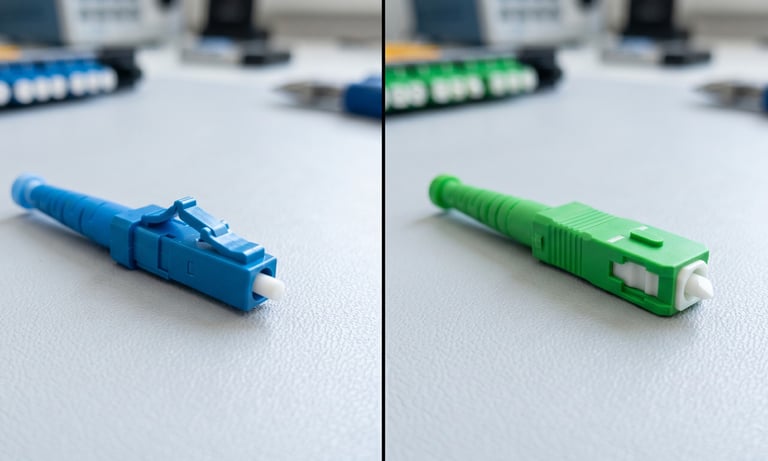
When two fiber optic connectors meet, the goal is for the glass cores to touch perfectly so light passes through without reflecting back. However, glass acts like a mirror. If there is even a microscopic gap, some light bounces back toward the source. This is called Back Reflection (or Return Loss).
To solve this, the ends of the fiber (the ferrules) are polished in two different ways:
UPC (Ultra Physical Contact - Blue): The end-face is polished with a slight rounded shape. This ensures the two cores touch at the very center. It works well for most digital data, but some light still reflects straight back down the core.
APC (Angled Physical Contact - Green): The end-face is polished at a precise 8-degree angle. Because of this angle, any light that reflects doesn't go back down the core; it bounces off at an angle into the "cladding" (the outer layer) and is absorbed.
The Golden Rule: You can never mix the two. If you plug a green (APC) connector into a blue (UPC) port, the angled face won't flush against the flat face, creating a huge gap and potentially damaging the glass.
The Modern Trend Update: The Rise of All-APC in Data Centers Historically, APC (green) was only used for cable TV or long-haul service provider networks because they were sensitive to reflections. However, in 2026, as we move to 400G and 800G speeds, the "noise" created by back-reflections in standard UPC connectors is becoming a dealbreaker. We are seeing a massive shift where even internal data center patch panels are moving toward all-APC (Green) architectures to ensure the signal-to-noise ratio is high enough for AI workloads.