
The Physics of Light in Glass
How fiber optics works
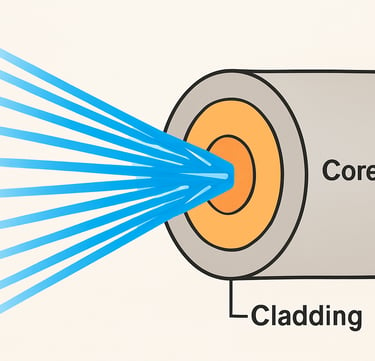
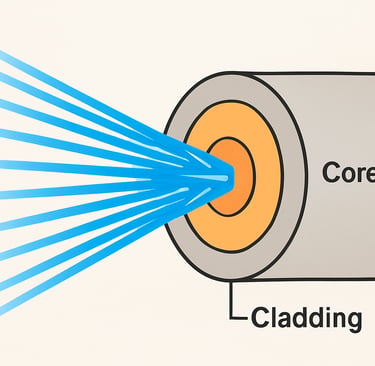
To understand fiber optics, you have to understand how light behaves when it moves through different materials. The two most critical concepts are Total Internal Reflection (TIR) and Attenuation.
Core vs. Cladding
A fiber optic cable consists of a central glass "core" surrounded by another layer of glass called the "cladding." The core has a slightly higher refractive index than the cladding.
Total Internal Reflection (TIR): Because of this difference in the refractive index, when a laser shoots light into the core at the correct angle, the light doesn't pass through the cladding. Instead, it acts like a mirror, bouncing the light back into the core, allowing it to travel down the cable.
Attenuation: Even though glass is clear, it isn't perfect. As light travels over kilometers, impurities in the glass absorb or scatter some of the light. This weakening of the signal over distance is called attenuation.
Visualizing Fiber: The Mirrored Highway
Think of the fiber's core as a long, mirrored tunnel and the light as a car speeding down it. As long as you steer the car into the tunnel at a shallow enough angle, it won't crash through the walls; instead, it perfectly bounces side-to-side off the mirrors, racing forward without ever leaving the roadway—this is Total Internal Reflection.
However, the tunnel isn't entirely spotless. Over miles of travel, the car inevitably runs into microscopic patches of "smog" or dust caused by impurities in the glass. Every time the light hits these particles, a tiny fraction of its energy is scattered or absorbed, slowly draining the signal's strength the further it travels—this fading is what we call attenuation.
The Modern Trend Update: Hollow Core Fiber (HCF)
While traditional solid glass cores have been the Fiber Optic standard for decades, the industry is currently shifting. Recent developments use an air-filled central channel instead of glass. This new fiber is called Hollow Core Fiber (HCF).
Because light travels roughly 30% faster through air than through silica glass, HCF drastically reduces latency—a massive priority for AI data centers where every microsecond counts.