
Single-Mode vs. Multi-Mode Fiber Demystified
Understand the difference between Single-Mode (SM) and Multi-Mode (MM) Fiber
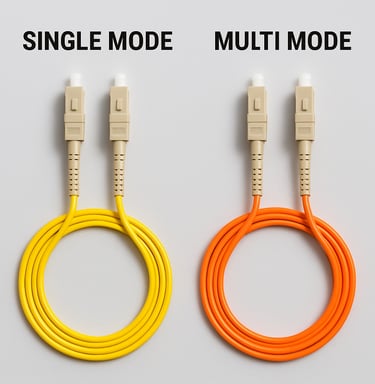
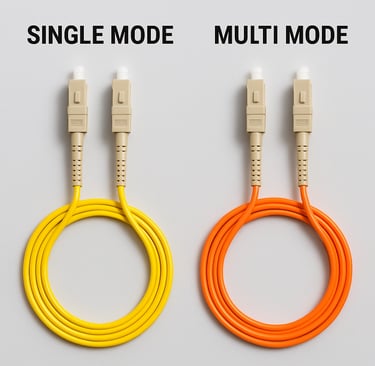
The physical difference between Single-Mode (SM) and Multi-Mode (MM) fiber comes down to one tiny measurement: the diameter of the glass core.
Multi-Mode Fiber (MMF): Has a larger core (typically 50µm). Because the core is wider, it allows multiple rays of light (called "modes") to enter and bounce around at different angles as they travel down the cable.
Single-Mode Fiber (SMF): Has a tiny core (9µm). It is so narrow that it forces the laser light to travel in one single, direct path straight down the center, with practically no bouncing against the cladding.
The Big Problem: Modal Dispersion
In Multi-Mode fiber, because the light rays are taking different bouncing paths, some arrive at the destination slightly faster than others. Over short distances, the receiver can still read the signal. But over longer distances (or at very high speeds), the signals overlap and smear together, causing data errors. This "smearing" is called Modal Dispersion, and it is the reason Multi-Mode is restricted to short distances. Single-Mode fiber eliminates modal dispersion completely.
Visualizing Dispersion: The Highway vs. The Bullet Train
Imagine Multi-Mode fiber as a wide, multi-lane highway and the light rays as a fleet of cars leaving a starting line at the exact same moment. Because the highway is wide, the cars take different routes—some drive straight down the middle, while others weave and bounce along the outer lanes, traveling a slightly longer distance.
By the time they reach a distant finish line, the pack of cars has stretched out and they arrive at different times. This timing delay causes the data to overlap and smear into an unreadable mess, a problem known as modal dispersion.
Single-Mode fiber fixes this by acting like a narrow, single-track bullet train; with only one direct path available, the light cannot bounce around, ensuring the entire signal stays perfectly grouped and arrives at the exact same instant, no matter how far it travels.
The Modern Trend Update: The 2026 "Physics Wall" in AI Data Centers
Historically, data centers used Multi-Mode (OM3/OM4) for connections within the same room because the optical transceivers were much cheaper.
However, as of mid-2026, the massive data demands of AI clusters (running at 800G and moving toward 1.6 Terabit speeds) are hitting a physics wall. At these ultra-high frequencies, the modal dispersion in even the best Multi-Mode fiber (OM5) limits reliable transmission to less than 30 meters. Consequently, modern AI infrastructure is rapidly standardizing on Single-Mode (OS2) cabling everywhere to support low-power Linear Pluggable Optics (LPO), effectively making SMF the default for both long-haul and inside-the-data-hall connections.