
Decoding Fiber Connectors – LC vs. SC vs. FC
Understand the difference between big 3 fiber connectors LC , SC and FC
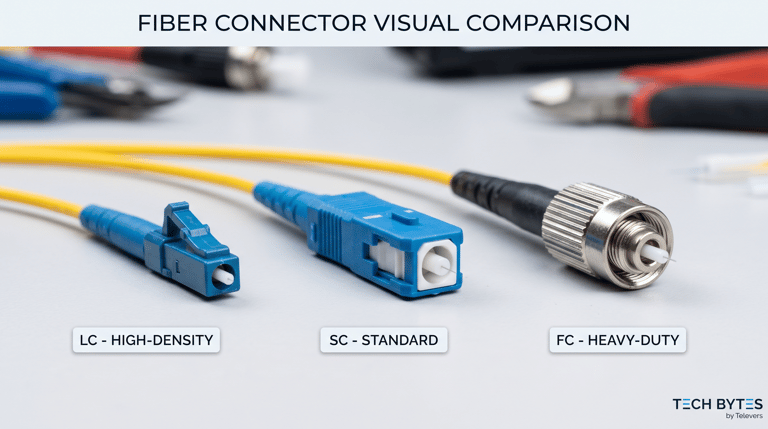
Specifying the right fiber optic connector isn't just about getting two cables to mate. It’s about optimizing rack density, ensuring physical stability, and matching your active hardware.
Here is your 60-second, no-fluff breakdown of the big three—LC, SC, and FC—so you can spec your infrastructure with confidence.
1. LC (Lucent Connector): The High-Density King
The LC is a Small Form Factor (SFF) connector that has become the absolute standard for modern, high-speed networking.
Mechanism: Push-pull latch (similar to a standard RJ-45 ethernet plug).
Ferrule Size: 1.25mm.
Where to use it: Data centers, high-density patch panels, and modern network switches. Because it takes up half the footprint of an SC connector, it is the default interface for SFP, SFP+, and QSFP transceivers.
2. SC (Subscriber Connector): The Reliable Workhorse
Often referred to as the "Standard Connector," the SC features a square, plastic housing. It is larger than the LC but is incredibly rugged and widely deployed.
Mechanism: Push-pull snap lock.
Ferrule Size: 2.5mm.
Where to use it: Telecom networks, passive optical networks (GPON/EPON), and Fiber-to-the-Home (FTTH) deployments. If you are dealing with carrier handoffs or older enterprise legacy fiber, you will see a lot of SC.
3. FC (Ferrule Connector): The Heavy-Duty Anchor
Built with a round, metal housing, the FC was one of the first connectors to use a ceramic ferrule. It prioritizes absolute physical stability over quick installation.
Mechanism: Threaded screw-on.
Ferrule Size: 2.5mm.
Where to use it: High-vibration environments (industrial sites, moving platforms, military applications) and precision test equipment (like OTDRs). It takes longer to plug in, but the threaded connection guarantees the fiber end-face won't disconnect or shift under physical stress.
Field-Tested Best Practice: Remember that connector type (LC/SC/FC) is just half the battle; the polish matters just as much. Never mate an APC (Angled Physical Contact, usually green) with a UPC (Ultra Physical Contact, usually blue). Mismatching them will crush the glass cores, causing severe signal loss and permanent hardware damage.