
MPO Base-8 Revolution
Why 12-Fiber MPO is Losing Ground
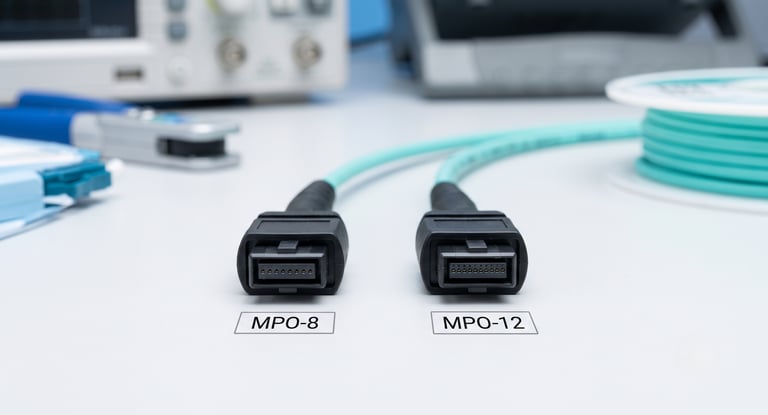
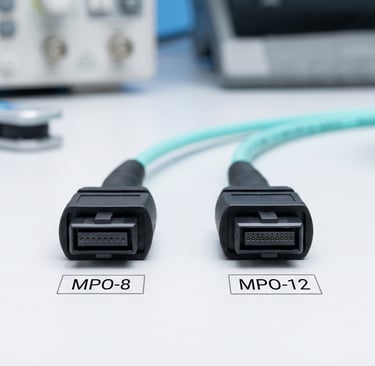
For years, the 12-fiber MPO connector was the undisputed backbone of data center cabling. But as networks scale to 40G, 100G, and beyond, legacy Base-12 infrastructure is leaving a lot of money and capacity on the table.
Here is a quick breakdown of why Base-8 is taking over modern parallel optics.
The Math Behind the Migration
Modern high-speed transceivers (like 40GBASE-SR4 and 100GBASE-SR4) rely on parallel optics. Instead of sending one massive signal down a single fiber pair, they split the data into multiple lanes:
4 Transmit (Tx) fibers
4 Receive (Rx) fibers
Total = 8 fibers required.
The Problem with Base-12 (12-Fiber MPO)
If you plug an 8-fiber transceiver into a standard 12-fiber MPO trunk, you only use the outer 8 fibers. The middle 4 fibers are completely unused. That means 33% of your expensive backbone fiber goes completely dark. In a massive data center, that wasted capacity translates to significant financial loss and wasted rack space.
The Solution: Base-8 (8-Fiber MPO)
Base-8 infrastructure aligns perfectly with SR4 transceivers.
100% Fiber Utilization: Every glass strand is actively passing data.
Cleaner Upgrades: Scaling from 40G to 100G, or even breaking out to 400G, becomes a simple 1:1 patch without complex conversion modules.
What about 24-Fiber MPO?
Base-24 is used for high-density 100G (SR10) links, giving you three 8-fiber links in a single connector. It's excellent for cross-connects, but the connectors are heavier and require more careful cable management to avoid stressing the ports.
Best Practice: If you are designing a greenfield data center today, heavily evaluate a Base-8 architecture. It future-proofs your parallel optic deployment and ensures you aren't paying for glass you will never light up.