
Tight Buffered vs. Loose Tube vs. Ribbon
The internal architecture of Fiber cables
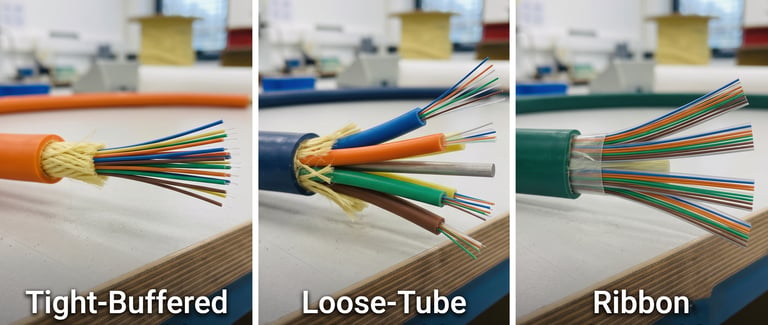

Tight Buffered vs. Loose Tube vs. Ribbon – The Internal Architecture of Fiber
When specifying fiber optics, the glass core transmits the data, but the internal architecture dictates how fast you can deploy it and whether it survives the installation.
Here is your 60-second guide to the three core internal fiber constructions.
1. Tight Buffered: The Direct Termination Champion
In this design, a thick plastic coating (900µm) is extruded directly over the bare glass fiber.
The Mechanics: Because the buffer is bonded tightly to the fiber, it is rugged and easy to handle by hand.
The Advantage: Fast, direct termination. You can crimp or epoxy standard LC/SC connectors directly onto the 900µm buffer without needing breakout kits.
Where to use it: Indoors. It is the absolute standard for LANs, data center patching, and intra-building backbones.
2. Loose Tube: The Environmental Shield
Here, bare fibers (250µm) float freely inside a semi-rigid plastic tube. The empty space is often filled with water-blocking gel or dry swellable tape.
The Mechanics: The "loose" design physically decouples the fragile glass from the outer jacket. If the jacket expands in summer heat or shrinks in winter freezing, the glass inside is completely undisturbed.
The Advantage: Ultimate immunity to extreme temperature fluctuations and moisture.
Where to use it: Outside Plant (OSP) environments, including underground conduits and long-haul runs.
3. Ribbon Fiber: The Hyperscale Scaler
Instead of individual loose fibers, 12 bare fibers are bonded side-by-side in a flat, ribbon-like array.
The Mechanics: Multiple ribbons are stacked on top of each other inside a single central tube, packing thousands of fibers into a relatively small cable diameter.
The Advantage: Mass-fusion splicing. Instead of splicing one fiber at a time, a technician can splice an entire 12-fiber ribbon simultaneously, cutting installation time by up to 80%.
Where to use it: Data center interconnects (DCI), hyperscale facilities, and AI clusters where ultra-high fiber counts (864, 1728, 3456+) are mandatory.
Field-Tested Best Practice: If you are paying technicians by the hour, keep termination in mind. Tight-buffered is cheaper to terminate per strand for low-count indoor runs, but ribbon fiber pays for itself massively in labor savings when splicing high-count backbones.