
Indoor vs. Underground vs. Aerial
Deploying the Right Fiber Cable
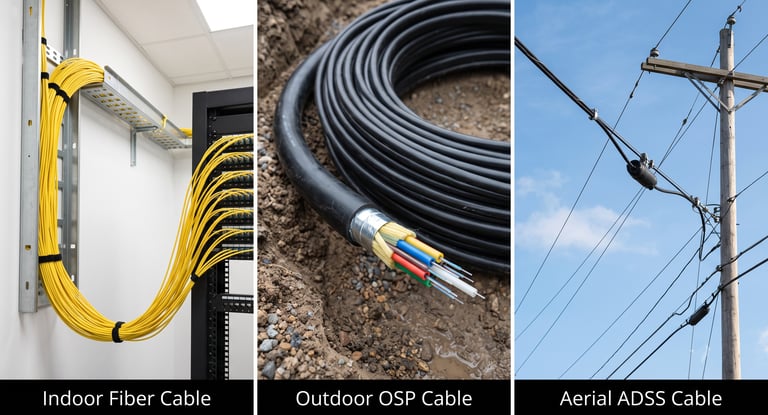
Specifying a fiber cable isn't just about bandwidth; it's about matching the jacket and mechanical reinforcements to the harsh realities of the physical environment. Put the wrong cable in the air or under the ground, and your network is on borrowed time.
Here is a fluff-free breakdown of deployment environments and the cables engineered to survive them.
1. The Indoor Workhorse (Tight Buffered)
Cables run inside buildings don't have to fight weather, but they do have to fight fire codes and tight corners.
The Design: Built with tight-buffered fibers for easy patching and wrapped in specialized, flame-retardant jackets (LSZH, Plenum or Riser).
The Deployment: Dropped in cable trays, pulled through interior walls, and routed through dense telecom closets.
The Rule: If it goes through spaces used for building air circulation (plenums), it must be rated LSZH (Low Smoke Zero Halogen) or OFNP (Optical Fiber Nonconductive Plenum) to prevent the spread of toxic smoke during a fire.
2. The Underground Survivor (OSP Loose Tube)
Cables buried in the dirt or pulled through subterranean conduits face constant threats from standing water, freezing ice, and rodents.
The Design: Utilizes a loose-tube internal structure packed with water-blocking gel. Often wrapped in corrugated steel tape (armored) and covered in a heavy UV-resistant Polyethylene (PE) jacket.
The Deployment: Direct burial trenches or underground duct banks. The steel armor prevents rats and gophers from chewing through to the glass core.
3. The Aerial Acrobat (ADSS)
Running fiber pole-to-pole across long distances requires a cable that can support its own weight, plus the added load of high winds and winter ice accumulation.
The Design: All-Dielectric Self-Supporting (ADSS) cables are heavily reinforced with aramid yarns (Kevlar) or central fiberglass rods.
The Deployment: Strung between utility poles or across rugged terrain where trenching is impossible. Because they are "All-Dielectric" (zero metal components), they can be safely run right alongside high-voltage power lines without acting as a lightning rod or causing grounding issues.
The Rule: Check the "Free span" specifications of the cable. "Free span" refers to the maximum distance an ADSS cable can safely hang between two utility poles without needing a separate messenger wire to hold it up.
Field-Tested Best Practice: The 50-Foot Rule. Unrated outdoor OSP cable should generally only be run a maximum of 50 feet indoors before it must be terminated or transitioned into a fire-rated indoor cable. Never run black, unrated OSP polyethylene cable deep into your server room.